Curriculum Intent and Design
Here you can find out about our approach to the curriculum at Holbrook. The links will take you to specific information about each subject area. For further information about the subjects taught in our curriculum you can access the National Curriculum for KS1 and KS2 (Click here). If you have any questions or would like to know more about what your child learns at Holbrook, please speak to your child’s class teacher. See below for our curriculum intent and implementation.
Our Curriculum: Intent
At Holbrook we seek to provide exciting learning opportunities for children to foster enthusiasm for learning. We believe that the curriculum should help children to experience 'life in all its fullness’ so our thematic curriculum includes regular opportunities for enrichment including visits, theatre trips, visitors into school and outdoor learning in our wonderful setting. We aim for a curriculum which is broad and rich to help children find their talents and passions. We have designed and personalised our curriculum to ensure that all children leave us with a wide foundation of knowledge, the necessary skills to be successful, lifelong learners and a passionate curiosity about the world around them. A focus on 'cultural capital' in every subject area helps us to ensure that children experience the best of what has been thought, said, achieved or created.
In order to support children to 'live life in all its fullness', our curriculum is underpinned by some key drivers:
- Success for all: we are committed to academic excellence, using the endpoints of the national curriculum to aim high. We support all pupils, particularly those with special educational needs, or who are from disadvantaged backgrounds to make rapid progress and to be successful in their learning
- Ready for the future: as well as academic achievement, we look at opportunities in the curriculum to prepare children for their future. Careers education, an emphasis on oracy, a focus on exploration of the world’s issues and challenges, and threads of diversity and inclusion all run through our carefully planned curriculum, so that children go into the world aspirational and ready to make contributions to their communities.
- Life-long, curious living and learning: through our curriculum we help children to become self-motivated, independent learners. We provide learning experiences which are exciting, enriching and challenging, and which expose children to the best of the cultures of the world.
Our Implementation Through Routines:
At Holbrook, we deliver our curriculum through routines. Our routines have been carefully designed, developed and adapted in order to distil them into their key components and provide a clearly recognisable, research-based and context-specific structure to our lessons and learning sequences.
Each routine provides a basic outline for building and enhancing learning in their specific subject areas whilst also enabling flexibility to allow teachers to continue to adapt lessons to their own strengths as well as their children’s unique needs each year.
By using simple, clear symbols, children are consistently reminded of their progress through a lesson and a subject whilst also having the expectations for independence and effort subtly and regularly reinforced during their learning.
Furthermore, these routines provide consistency across all classes which enables smooth transitions between year groups (including those split across classes) and a clear framework for analysing and improving the effectiveness of the different stages within our lessons.
Our aim is for every class to use consistent routines for their learning with recognisable, visual symbols which enable children to be aware of and understand the entire process of engaging with new content. In most lessons, the symbol for the stage of the process that the children have reached is displayed or referenced in order to support this.
Through using our routines, we aim to maximise pupil learning in lessons and sequences of lessons; support children in developing their independence and passion for learning; provide a framework for analysing lessons to support the continual professional development of all staff; and create a viable, research-based and context-specific approach of learning to meet the needs of all our pupils.
Our Curriculum: Design
At Holbrook, we have a rolling programme for our curriculum. In EYFS, there is a one year repeated cycle. In KS1, the foundation subjects are taught on a two year cycle. Classes 3 and 4 (Years 3, 4 and 5) have a three year cycle, and our Year 6 have a standalone one year cycle.
In our foundation subjects, we imagine our curriculum as a library!
In all subjects, the books get harder as you move through the year groups. This is due to our disciplinary knowledge progressing, ensuring children
become better historians, better artists, better geographers as they move through the year groups.
In some subjects, even though the books get harder, you can read them in any order (e.g. History—you can read each book on Stone Age, Romans, Egypt in any order, but the book gets harder from Y3 to Y4 to Y5). This means that children will always learn the same granular knowledge from each unit, but will access it in more challenging ways through the progressive
disciplinary knowledge
In some subjects, the books still get harder as you move through each year group, but they are arranged in to book series, so you have to read them in some sort of order (e.g. in science you must read the light books in order, or the electricity books, and in computing, you must read all of the programming books in order).
This means that children improve in each subject progressively, but they all leave our school having experienced our full curriculum, having learned all the substantive knowledge, having read every book in our Holbrook “Curriculum Library!”
To ensure rigour, each subject has a set of 'red letter learning' for each topic. This is the key knowledge and skills we have identified as crucial for our children to have learned before they leave their key stage. Teachers ensure this knowledge is embedded through our 'look back, move on' sessions.
How does this work in practice?
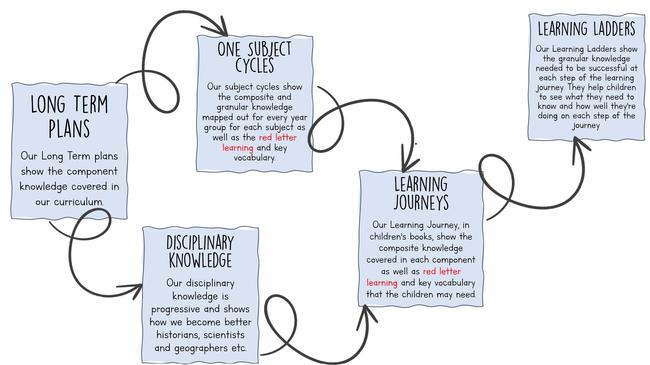
Our Long Term Plans show the components of our curriculum.
Our Disciplinary Knowledge is mapped out on progression grids, to show how we become better historians, scientists, geographers etc over time.
Our One Subject Cycles show each composite step, the granular knowledge needed and our 'red letter learning' which is the substantive knowledge that we really want to 'stick'.
Learning journeys show the children each composite steps for each unit of work. They also show the disciplinary knowledge and key vocabulary, as well as the 'red letter learning'. This helps children to know where they have been in their learning and where they are going next.
Learning ladders for each lesson really dig down into the substantive knowledge, showing the granular detail which is the focus of our teaching and learning. It helps the children to understand what exactly they need to know as well as how well they are doing at each step.
Have a look at our long-term plans. They shows where we teach all the units of learning for every subject. In Key Stage 1 and Key Stage 2, for foundation subjects (such as History, Geography or DT) we think carefully about the order of learning within a year and across the whole school. Learning in EYFS provides the building blocks for units in Key Stage 1. This then links to further learning in our two mid Key Stage 2 classes, and then the final development in Year 6, where children achieve the end point in their primary school learning.
Continuous Provision
At Holbrook, we use Continuous Provision in both of our Key Stage One classrooms in order to offer a dynamic learning environment that nurtures children's curiosity, creativity, and resilience. Informed by recent research highlighting the benefits of play-based learning, this approach not only supports academic achievement but also promotes holistic development, preparing children for success in school and beyond.
Our belief is that through our continuous provision we can create enriching learning experiences that inspire a lifelong love of learning.
Have a look at our Continuous Provision blueprint below: