History
History 'in all its fullness'
Statement of Intent
At Holbrook we believe that the study of history should stimulate children’s interest and understanding about the life of people who lived in the past. Our curriculum is rooted in developing children’s understanding of chronology, and in an exploration of issues relating to past societies. We draw links between the past and the present and encourage children to think like historians: look for evidence, justify their thoughts and consider reliability, bias and accuracy. The study of history promotes critical thinking and a questioning attitude.
We aim to make all children aware of the actions of important people in history and enable children to know about significant events in British and international history, whilst appreciating how things have changed over time. Our curriculum is inclusive of different groups and communities, paying attention to those whose place in the history books has been traditionally sidelined or ignored.
Implementation
- There is a rolling program at Holbrook – a two year cycle in KS1, a three year cycle in KS2 and Year 6 has stand alone topics.
- The rolling program means that chronology is a key tenet of each unit, children regularly return to timelines, making links between the eras studied and building an understanding of how these are sequenced
- We have a topic approach to learning, which allows cross-curricular links between subjects. Each term, our classes also have key texts which, for history based topics, help to provide meaningful links and context.
- Clear identification of core vocabulary and ‘red letter learning’ sets out what all children should know before they leave Holbrook. Children will return to this core learning again and again through school to ensure mastery of the curriculum.
- All subjects at Holbrook have learning journeys which set out the progression through a unit. Units are often taught in a block to allow children to develop a deep understanding and immersion in the learning.
Our curriculum approach is carefully designed so that learning in the Early Years is built upon in Key Stage 1 and then again in Key Stage 2, so no matter the cycle, there are always clear links to earlier and future learning. You can see an example of how we make links below.
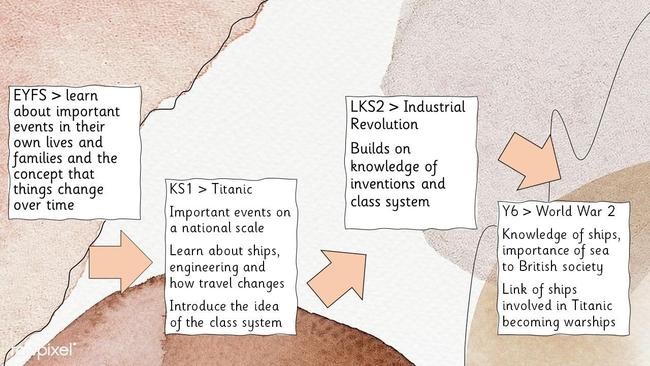
Curriculum planning documents for History
How we adapt the Curriculum for SEND Pupils
As part of our high quality approach to teaching, we use a range of strategies to support SEND pupils to access the History curriculum. The document below details examples of the adaptations that are made to support pupils in class.
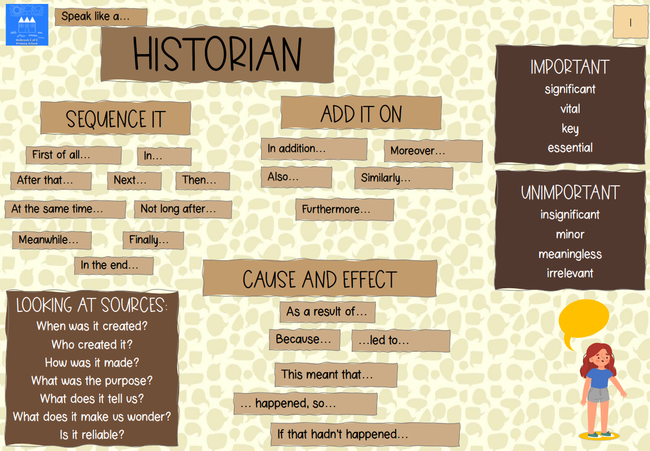
Oracy in History
At Holbrook, we aim to help pupils share their ideas and understanding to their full potential. In our history lessons, we place emphasis on improving our oracy skills, and one of the methods we use is the use of 'Speak like a Historian' prompt mats. These mats provide students with sentence stems, prompts, and vocabulary related to discussions and debates about our chosen focuses in history. By encouraging students to structure their sentences, conversation and debates, we enable them to access learning on a deeper level as well as preparing them for life in the wider world.
How this fits within our school vision
Our school vision, to live ‘life in all its fullness’, reminds us that the primary school history curriculum is more than memorising facts and dates: it is also about developing a deeper understanding of the world around us, and the people and events that have shaped it. Our history curriculum helps students to develop empathy and understanding towards others, as they learn about different cultures, traditions and ways of life. By providing students with a rich and diverse historical education, we help them to develop the knowledge, skills and attitudes they need to live fulfilling and meaningful lives.