Modern Foreign Languages
Intent
At Holbrook CE Primary School, we believe that learning a foreign language is a necessary part of being a member of a multicultural society and provides an opening to other cultures. It should provide opportunities for pupils to communicate for practical purposes, learn new ways of thinking and read in the original language. Language teaching should provide the foundation for learning further languages, equipping children to study and work in other countries.
“A high-quality languages education should foster pupil’s curiosity and deepen their understanding of the world. The teaching should enable pupils to express their ideas and thoughts in another language and to understand and respond to its speakers, both in speech and in writing.” (National Curriculum 2014 – Appendix A)
The national curriculum for languages aims to ensure that all pupils:
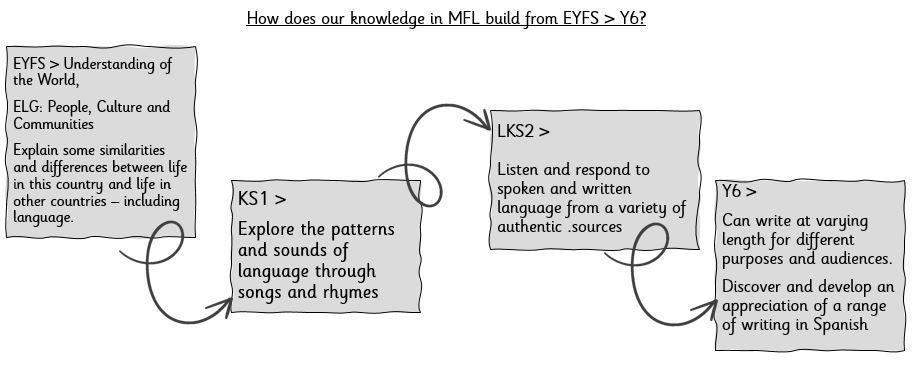
- Understand and respond to spoken and written language from a variety of authentic sources
- Speak with increasing confidence, fluency and spontaneity, finding ways of communicating what they want to say, including through discussion and asking questions, and continually improving the accuracy of their pronunciation and intonation
- Can write at varying length, for different purposes and audiences, using a variety of grammatical structures that they have learnt
- Discover and develop an appreciation of a range of writing in the language studied (Spanish)
At Holbrook CE Primary School we believe that children really enjoy learning to speak another language. We also believe that the earlier a child is exposed to a foreign language, the faster the language in question is acquired.
Implementation
In line with the National Curriculum for MFL, pupils at Holbrook CE Primary school are taught to:
- listen attentively to spoken Spanish and show understanding by joining in and responding
- explore the patterns and sounds of Spanish through songs and rhymes and link the spelling, sound and meaning of words
- engage in conversations; ask and answer questions; express opinions and respond to those of others; seek clarification and help
- speak in sentences, using familiar vocabulary, phrases and basic language structures
- develop accurate pronunciation and intonation so that others understand when they are reading aloud or using familiar words and phrases
- present ideas and information orally to an audience
- read carefully and show understanding of words, phrases and simple writing
- appreciate stories, songs, poems and rhymes in the language
- broaden their vocabulary and develop their ability to understand new words that are introduced into familiar written material, including through using a dictionary
- write phrases and adapt these to create new sentences, to express ideas clearly
- describe people, places, things and actions orally and in writing
- understand basic Spanish grammar, including feminine, masculine and neuter forms and the conjugation of high-frequency verbs; key features and patterns of the language; how to apply these, for instance, to build sentences; and how these differ from or are similar to English.
This is done through regular lessons. Classes are mixed age however, disciplinary skills are taught progressively.
Although structured learning begins in KS2, younger children are introduced to Spanish using classroom routines (register), songs, games and ICT.
Impact
We measure the impact of our curriculum through the following methods:
- Observing children speaking and listening in another language.
- Marking of written work.
- Images and videos of children completing speaking and listening activities.
- Interviewing the pupils about their learning (pupil voice).
- Annual reporting of standards across the curriculum to parents.
- Subject tracking.
By the time they leave at the end of Year 6, children will have developed the necessary transferable skills for language learning. These skills will be important as children go on to study a range of different languages at KS3.
How we adapt the Curriculum for SEND Pupils
As part of our high quality approach to teaching, we use a range of strategies to support SEND pupils to access the MFL curriculum. The document below details examples of the adaptations that are made to support pupils in class.
How this fits within our school vision
Through our Spanish curriculum, we aim to broaden our pupils' horizons by immersing them in a new language and culture, fostering an appreciation for diversity and global connections. Learning Spanish allows pupils to communicate with others across the world, opening their minds to different perspectives and ways of life. In this way, we encourage pupils to experience ‘life in all its fullness,’ reflecting the vision of John 10:10.